Why We Want to Believe Love Can Be Earned
Friday, June 26, 2026
Issue # 265

Hello there!
This week in my holistic psychiatry practice, a similar theme appeared in one patient after another. Each person had a similar root problem that made them perpetually vulnerable to misery. Their “symptom,” if I can even call it that, was characterized by an insatiable need to fill an emotional hole that could never be satisfied.
One man needed to be liked—by everyone. He was liked by just about everyone, but it was never enough. If he were to do anything less than likable, he would beat himself up and suffer for many days.
He grew up in a divorced family where his mother groomed him through guilt and fear to please her. As a child, she used him to protect her from lascivious adult men she brought to their home. If he didn’t please her, she would threaten to ruin his relationships with others or to abandon him. Because she enjoyed having him sing to her, he sang her favorite songs.
Another woman needed to be perfect, but never felt she was perfect enough in her roles as a wife and mother. She always felt as if she fell short of her own expectations, such as being patient with her young children. She had so many things she needed to do to meet her perfectionistic standards that just the thought of all the tasks ahead of her felt exhausting and paralyzing.
What is the root of both their problems that naturally occur during almost everyone’s childhood?
The egocentric belief that one has control over access to love (through attention, approval, and nurture).
Egocentric isn’t the same as selfish. Egocentricity is natural for children because they assume the world revolves around them.
What does a child value most in life? It’s love. Love is food for the soul. Without love, children can die, even if their physical needs are met.
However, long before the use of words, children learn to manipulate their environment and the amount of love and attention they receive through their behaviors. After all, didn’t the caregiver come when they cried loudly enough?
It’s just another small half-step to conclude that more of “X” would lead to more of “Y.” In other words, more “__ behavior” would lead to more “nurturing, loving responses.”
Soon, a Pavlovian, life-long cycle of “earning” love through repetitive performance ensues—a conditioned response linked to conditional love—the greatest reward of all.
Once that foundation is formed, the level of need often reflects the child’s lack of love during their early development. Some children develop in a metaphorical Valley of Milk and Honey where love is abundant and overflowing. Some are born in the middle of the Mojave Desert.
If a child develops in the Mojave Desert of Love, that child will experience powerful pressure to perform at a consistently high level to fill their little cup with a bit of life-sustaining love.
When I meet people with an intense drive to earn love and yet never feel satiated, I wonder about their developmental desert. How much was neglect or abuse a part of their early years?
We know the root of the problem: the belief that love must be earned.
We know the condition it creates: the intense need to perform in a particular way to feel loved (or its equivalent, such as approval).
But what can be done to resolve this?
First, the answer is to trash all the false assumptions and start with a clean slate of truths:
True love is unconditional.
Unconditional love is free. It is also easily accessible.
One does not need to “earn” it through achievement or performance.
How, then, can we access this “unconditional love?”
Here’s where the quantum aspect of my humble holistic psychiatric practice comes in, since I work with energy in different forms.
The truth is that love is an energy.
It is part of the life energy within us and around us.
We can tune into a loving source of life energy through our thoughts and intentions.
When we use the mind to access a loving source of life energy, we become stronger—literally and physically.
There is a way to test and see if people become stronger when they use their mind to focus on the idea of a loving source of energy. Invariably, their energy increases, and they test as being physically stronger.

During my sessions, I like using an energy psychology technique that is called Empower Energy Technique, or simply EET, to help patients access and shift energy.
EET uses the mind through intentions, words, and the idea of a perfect source of loving energy to heal a person’s energy system. The energy system is foundational to every aspect of life, physically and emotionally. So, helping the energy system leads to improving other aspects of the person’s well-being.
I used the following EETs to help the two patients I mentioned earlier:
The patients used intentions and repeated the following scripted phrases three times:
Empower Energy Technique (EET) On Healing the Need to Be Perfect
I now choose to be one with Loving Life Energy as a wave is one with the ocean or as a sunbeam is one with the sun and be empowered to ___.
1. Heal, clear, and release the false belief that I’m not good enough until I’m perfect.
2. Heal, clear, and release feeling paralyzed and overwhelmed by all the unrealistic expectations I place on myself.
3. Strengthen, support, and create the ability to have greater compassion, patience, and acceptance of my human limitations as I do my best.
4. Strengthen, support, and create the understanding that not being perfect all the time in fulfilling my roles is normal and human.
5. Strengthen, support, and create the ability to treat myself as I would treat friends or acquaintances, and be able to see my goodness easily and naturally.
I completely and gratefully accept healing energy at all levels of being and through space and time from this infinite source of Loving Life Energy to create and achieve this healing process. I embrace the positive shifts that occur as I heal my beliefs, emotions, fears, pain, habits, traumas, injuries, negative spiritual influences, brainwashing, and other blockages that prevent me from receiving all the helpful energy and support I need to heal and empower this healing process, at all levels of being, now and through space and time.
I used this EET for the man’s need to be liked:
Empower Energy Technique (EET) On Healing From the Need to Be Liked
I now choose to be one with Loving Life Energy as a wave is one with the ocean or as a sunbeam is one with the sun and be empowered to ___.
1. Heal, clear, and release my need to be liked by others in order to feel safe, good, calm, and acceptable.
2. Strengthen, support, and create the ability to compassionately and fully like myself as I am.
3. Strengthen, support, and create greater unconditional love and acceptance of myself despite my ignorance, shortcomings, mistakes, and weaknesses.
I completely and gratefully accept healing energy at all levels of being and through space and time from this infinite source of Loving Life Energy to create and achieve this healing process. I embrace the positive shifts that occur as I heal my beliefs, emotions, fears, pain, habits, traumas, injuries, negative spiritual influences, brainwashing, and other blockages that prevent me from receiving all the helpful energy and support I need to heal and empower this healing process, at all levels of being, now and through space and time.
After the energy “work,” each patient tested stronger when they connected to the energy being treated. Repetition can be helpful if doing it three times helped, but not as completely as one wanted.
If you want to learn more about holistic psychiatry, feel free to explore this on my website: Holisticpsychiatrist.com. There is a section on my website specifically dedicated to the Empower Energy Technique (EET). Click here to find it: Empower Energy Technique.
Have fun using these techniques and see if you find them helpful. There are other energy psychology techniques I’ve learned in the past, such as Ask and Receive, Tappas Accupressure Technique, Emotional Freedom Technique, and Logosynthesis. But I like using EET because it doesn’t require tapping the meridian points, and because it is, in my opinion, the most efficient way to create a shift in one’s energy state.
If you found this article helpful, please share it with others, subscribe to my Substack where I posted this article first, and support my writing as a paid subscriber. Your contribution to my success as a writer means the world to me!
Podcast from June 11, 2026. If you haven't had the chance to listen, enjoy!
Be sure to subscribe!
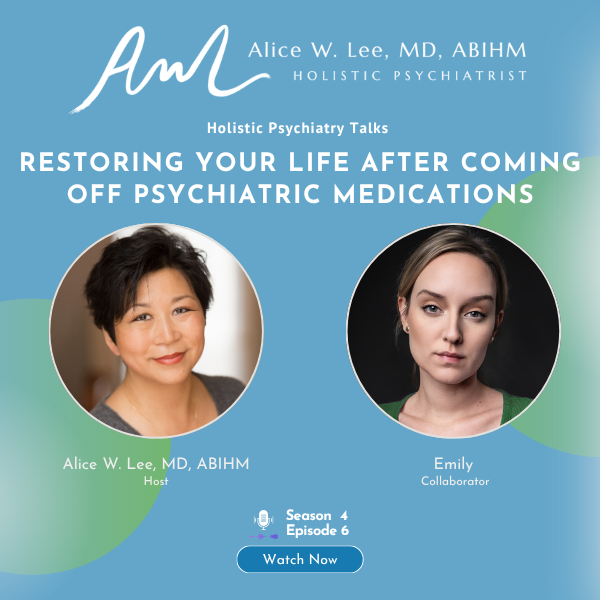
Restoring Your Life After Coming Off Psychiatric Medications
Who Am I and How Do I Move Forward?
Coming off psychiatric medications can feel like the end of a long and difficult journey. But for many people, it is also the beginning of a new one.
In this episode, Emily and I talk about what happens after medication withdrawal — when the body has healed, and the symptoms are gone, but the emotional, social, and practical challenges still remain.
We discuss the process of rebuilding confidence, identity, relationships, habits, and daily life after years of psychiatric treatment.
Emily shares her personal experience of feeling free after withdrawal, only to realize that there were still deeper layers to heal, including fear, loneliness, self-doubt, and the need to start over in many areas of life.
We also explore:
The emotional aftermath of psychiatric treatment
Why people may feel anxious even after a successful withdrawal
How medication, symptoms, and the psychiatric system can affect identity
The challenge of rebuilding friendships, work, and purpose
Why self-care habits can slip after recovery
How supplements, energy medicine, rest, and diet can support long-term healing
The importance of patience, compassion, and taking one small step at a time
This conversation is not only about coming off medications. It is about learning how to rebuild one's life after healing from a chronic medical condition.
It is about recognizing what you have survived, giving yourself grace, and moving forward with a life that feels whole, authentic, and free.
Enjoy!
Please come back for more episodes of The Holistic Psychiatrist!
If you've enjoyed this podcast, please give it a five-star review to help spread the word.
Visit holistipsychiatrist.com to contact me and to access more free articles and resources.
It takes time and money to produce these podcasts and videos. To sustain my work as a holistic psychiatrist and support my efforts to improve psychiatric treatment for all through my podcasts, articles, website, and YouTube channel, please show your appreciation and help champion holistic psychiatry by clicking HERE to contribute!
Click here to listen to all of The Holistic Psychiatrist Podcast episodes
Contact here to email Dr. Lee directly.
If you like this podcast, please give it a 5-star rating and share this with others! Thank you!
For more about Dr. Alice W. Lee, please visit:
Website: www.holisticpsychiatrist.com
More stories and insights: Holistic Articles
YouTube: The Holistic Psychiatrist
New! The Holistic Psychiatrist Substack: A space for my opinions and reflections on cultural, political, social, and psychological issues from the perspective of a holistic and integrative child, adolescent, and adult psychiatrist.
To schedule consultations or appointments, call Dr. Lee's office at 240-437-7600
Dr. Lee is located near downtown Stamford, Connecticut.
The content provided by this podcast is for informational purposes only and has not been approved by the U.S. FDA. This podcast is not intended to provide personal medical advice, which should be obtained from a medical professional.
