Underlying Causes for
Protracted Withdrawal
Thursday, April 2, 2026
Issue # 259

Hello there!
It is amazing how little is known about the long-term effects of SSRI exposure. It's almost as if it's not important.
Just like the topic of medication withdrawal, despite long years in training, physicians are left with little to no understanding of safe psychiatric medication withdrawal.
Some wonder if it's even possible. Perhaps it's impossible. Isn't mental illness a chronic disorder? Why bother to come off medications if they are the best treatment available for mental illness, and if mental illnesses will never resolve?
Would you get on a horse if no one knew how to get you off?
Would you enter a room if no one knew how to get you out?
Wouldn't you look for an alternative form of transportation besides a horse? Wouldn't you want to explore another room instead?
Today's article and podcast summarize what I've learned over the past three months about the long-term effects of SSRI exposure and how to help two patients recover from protracted withdrawal.
The battles for their recovery were as intense as any war abroad. The patients' will and determination needed to be as strong as a soldier, and they were. In the long run, they healed, and we all grew and advanced from our efforts.
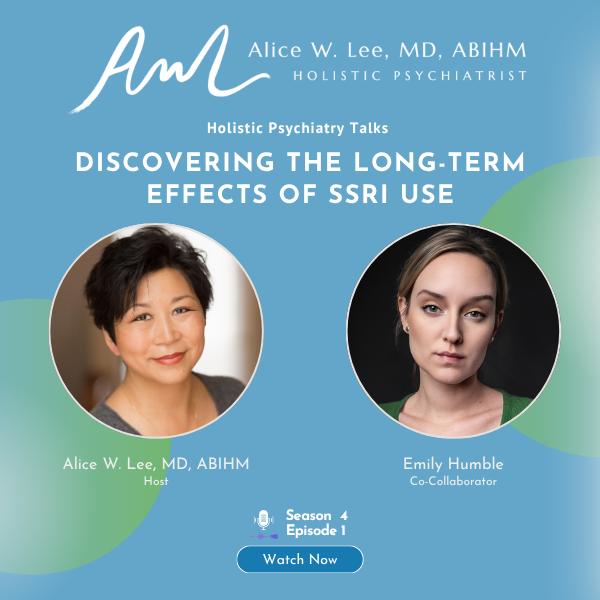
This podcast is special in another way. I have a wonderful, new co-host, Emily, who will be joining me on future podcasts as we explore holistic psychiatry together. Emily brings a wonderful, unique dimension to these podcasts that I hope you will appreciate.
Read on to discover the secret, underlying causes for protracted withdrawal that have important implications for understanding addiction and dependence on other pharmaceutical agents.
Have a bright and joyful spring week!
The Long-term Effects of SSRI Use
Underlying Causes for
Protracted Withdrawal
X and Y didn't know each other, but they shared startling similarities with backgrounds and duration of exposure to SSRIs.
X began taking Lexapro in 2018, and was on 15 mg per day when she began treatment with me in January, 2025. She had stopped Lexapro in 2019 and had a recurrence of severe symptoms in 2021, which led to restarting Lexapro.
Y was on 60 mg of Prozac since 2019 when he began treatment with me in February, 2025, but had been on a carousel of medications for the past 25 years, most of which he stopped on his own.
Both were determined to get off their medication using a holistic approach. And both had a fairly easy medication withdrawal . . . until three months after they came off their medications.
Today's podcast explores what I had to do to help both of them heal beyond all that I typically do for medication withdrawal, which included:

Spring day at the Bartlett Arboretum and Gardens
Stamford, CT
1. Neurotransmitter support with amino acids, vitamins, and minerals.
2. Hormonal support
3. Detoxification support
4. Gut/microbiome support
5. Healing from oxidative stress and inflammation
6. Healing from infectious sources
7. Nutritional repletion
8. Psychotherapeutic healing from past traumas
9. Healing from self-limiting patterns of thinking
Could there be more beyond that? Uh, yeah, there were.
I had to create new ways to measure underlying causes for protracted withdrawal and gather data about how these conditions shifted over time through energy work. Some of the areas we had to address were:
1. Genetic and enzymatic difficulties with creating serotonin or other neurotransmitters.
2. Inadequate detoxification process. Both are vegetarians and were not receiving liver glandular support during withdrawal, but needed it. Later, they both added it, and the glandular approach improved their conditions.
3. Regulatory genetic and enzyme issues not responsive to functional (nutritional) medicine support.
4. Damage and harm from the use of medications (directly due to medications (low liver enzymes) or due to the body's reaction to the medications (inflammation).
Special note: There's a likelihood that X began with genetic difficulties creating serotonin even before using any SSRI medication. So, going to 20% of optimal serotonin production for X may not be entirely due to downregulation of her genes and enzymes from using Lexapro.
Both X and Y have improved significantly over time. However, to buy some critical time, I did start X on 3 mg of Lexapro when she was suffering greatly from protracted withdrawal. Y has been improving his health over time without needing to go back to using Prozac.
For more details, listen to the podcast! Have a bright and colorful week!
Be sure to subscribe!
What are the long-term effects of SSRIs—and why do some people experience protracted withdrawal long after stopping antidepressants?
In this episode, Dr. Alice W. Lee sits down with Emily to explore the science and lived experience behind SSRI withdrawal, including persistent symptoms that can last months or even years. This conversation sheds light on protracted withdrawal syndrome, a condition that remains widely misunderstood in conventional psychiatry.
You’ll learn why withdrawal symptoms vary from person to person, the potential long-term impact of SSRIs on the nervous system, and whether full recovery is possible using a functional medicine and holistic psychiatry approach.
Dr. Lee also shares her latest clinical insights on healing from antidepressant-related damage, including what has worked for her patients through nutrition, targeted supplementation, and root-cause treatment strategies.
In this episode, we discuss:
What protracted withdrawal is and how it relates to SSRI use
Why withdrawal experiences vary from person to person
The possibility of long-term or lasting effects
New insights into post-SSRI healing
What has helped patients recover—and how long it can take
If you’re searching for answers about SSRI side effects, antidepressant withdrawal recovery, or natural mental health support, this episode offers both clarity and hope.
To sustain my work as a holistic psychiatrist and support my efforts to improve psychiatric treatment for all through my podcasts, articles, website, and YouTube channel, please show your appreciation and help champion holistic psychiatry by clicking HERE to contribute!
Click here to listen to all of The Holistic Psychiatrist Podcast episodes
Contact here to email Dr. Lee directly.
Join me on Substack for deeper stories, real talk, and exclusive content.
If you like this podcast, please give it a 5-star rating and share this with others! Thank you!
For more about Dr. Alice W. Lee, please visit:
Website: www.holisticpsychiatrist.com
More stories and insights: Holistic Articles
YouTube: The Holistic Psychiatrist
To schedule consultations or appointments, call Dr. Lee's office at 240-437-7600
Dr. Lee is located near downtown Stamford, CT.
The content provided by this podcast is for informational purposes only and has not been approved by the U.S. FDA. This podcast is not intended to provide personal medical advice, which should be obtained from a medical professional.
